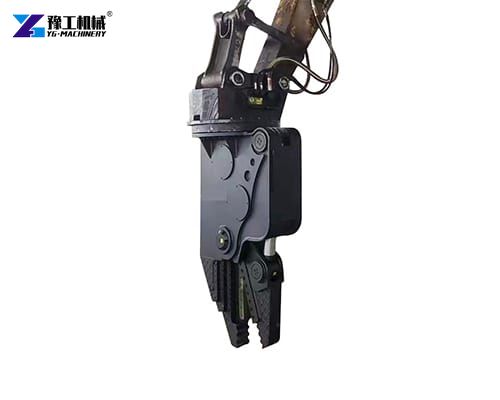
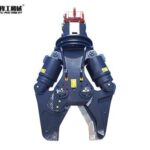
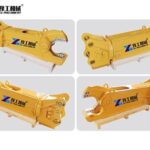
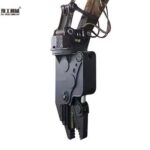
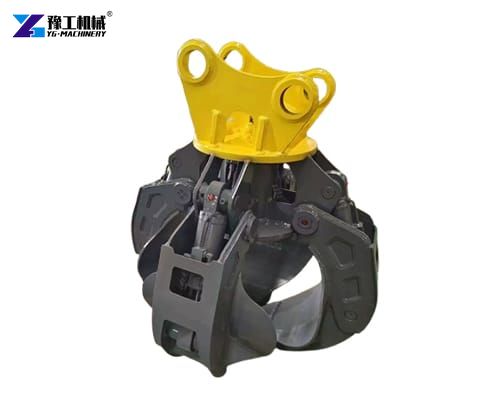
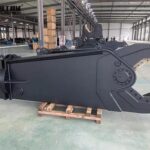
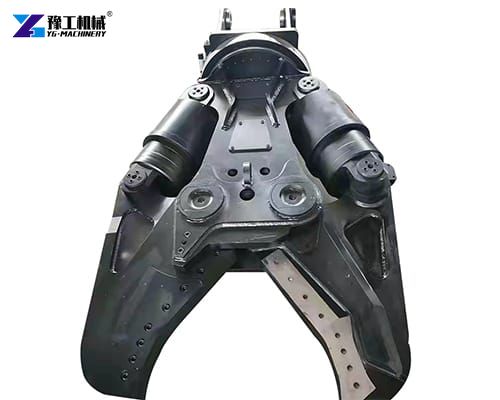
Hydraulic shear attachment for excavator is not merely a pair of giant scissors; it harnesses the excavator’s existing hydraulic system to generate immense cutting forces. Whether dismantling a high-rise building, processing scrap metal in a yard, or performing emergency rescue operations, the shear provides clean, fast, and controllable cuts. The most prominent feature of modern models is the full 360-degree hydraulic rotation system that allows operators to adjust the shear jaw angle in real time without repositioning the entire excavator. This means you can approach irregularly shaped structural components from any possible angle, reach into tight confined spaces that would be completely inaccessible to fixed-angle cutting tools, and make micro adjustments to the cutting position without wasting time repositioning the base machine.
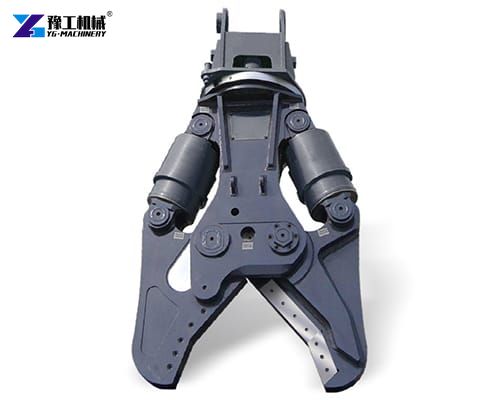
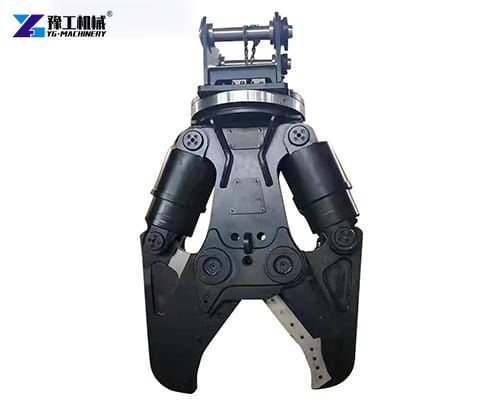
Parameters of the Hydraulic Shear Attachment for Excavator
| Model | YG-180 | YG-290 | YG-390 |
| Applied Excavator | 12-18T | 20-30T | 30-40T |
| Weight | 1600kg | 2800kg | 3600kg |
| Driving Pressure | 300Mpa | 320Mpa | 320Mpa |
| Oil Flow | 250L/min | 280L/min | 350L/min |
| Opening | 600mm | 740mm | 800mm |
| Shearing Depth | 460mm | 550mm | 650mm |
| Shearing Force | 108T | 156T | 250T |
| Overal Length | 1900mm | 2207mm | 2700mm |
Core Features of Hydraulic Shear for Excavator
Modern hydraulic shears are distinguished by several key features that directly impact their effectiveness.
First is the blade geometry; most high-end attachments employ a four-sided, reversible blade system that maximizes wear life.
Second is the jaw opening, which determines the maximum workpiece size. For instance, models designed for 12-18 ton excavators typically offer an opening around 600mm, while units for 30-40 ton machines can open up to 800mm, accommodating substantial structural elements.
Third is the shearing depth—the throat capacity—which often ranges from 460mm to 650mm, allowing operators to bite deep into thick sections.
Fourth is the rotational capability; many shears feature a full 360-degree hydraulic rotation, enabling precise positioning without repositioning the carrier machine.
Finally, speed valves and boost systems allow operators to balance between rapid closing for light materials and maximum force for tough alloys.
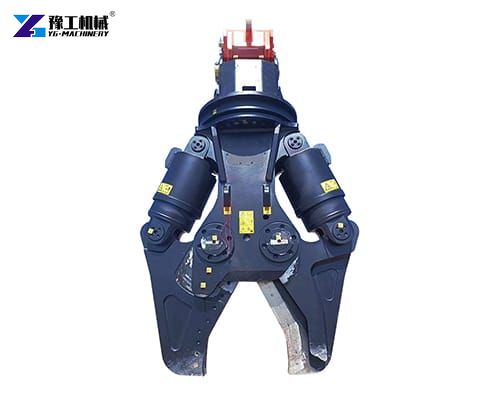
Diverse Applications of Hydraulic Shear Attachment
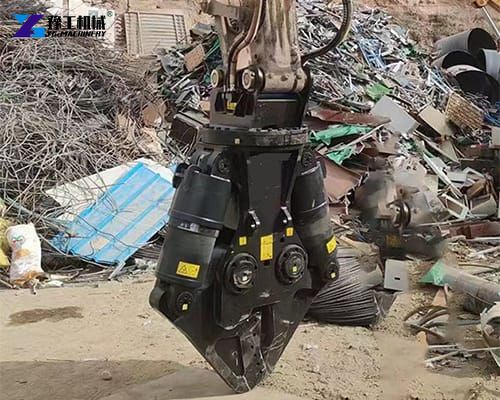
In demolition, it excels at floor-by-floor structural dismantling, cleanly separating rebar from concrete for subsequent crushing.
In scrap metal recycling, it reduces end-of-life vehicles, industrial machinery, and shipping containers into furnace-ready scrap.
Bridge dismantling projects benefit from its ability to cut through tensioned steel cables without the heat-affected zones created by torches.
Marine salvage operations use submersible variants to cut wreckage underwater.
Even in quarrying and mining, shears assist in breaking oversized boulders or cutting conveyor belt structures.
The attachment also finds niche roles in disaster response, where rapid cutting of tangled metal frames can save lives.
Structural Composition of the Hydraulic Shear
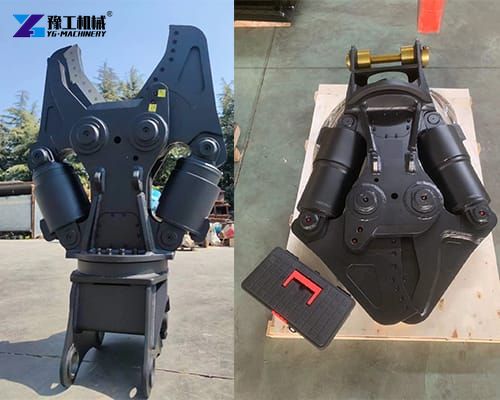
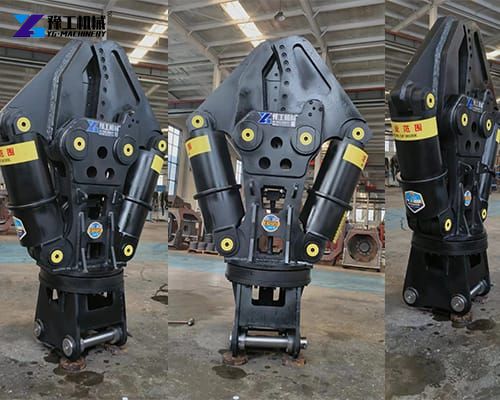
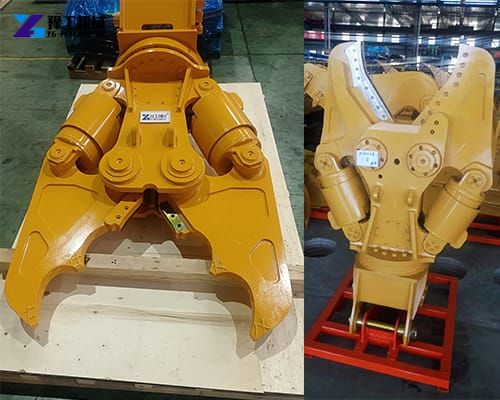
The main body comprises high-strength, abrasion-resistant steel plates, welded into a box-section design that resists torsional forces.
The fixed jaw and moving jaw form the cutting chamber, with the moving jaw pivoting on a heavy-duty, grease-lubricated pin.
The blade mounting system employs wedge locks or bolted retainers to secure the four cutting edges, allowing field rotation when one edge dulls.
Cylinders are mounted internally or externally; premium designs place the cylinder inside the pivot area to protect it from impact damage.
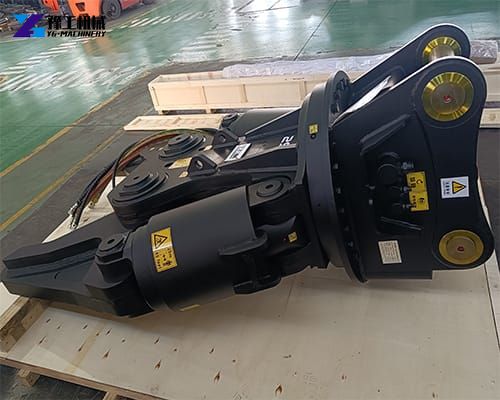
The rotator assembly, if equipped, includes a gear motor and slew ring, enabling continuous rotation under load.
Between the rotator and the excavator’s quick coupler lies a mounting bracket with reinforced bushings to absorb shock loads.
Wear plates and shims are strategically placed to maintain precise jaw alignment over thousands of cycles, ensuring clean cuts and prolonging blade life.
Working Principle: From Hydraulic Flow to Shearing Action
The excavator’s hydraulic pump sends pressurized oil through the control valve to the shear’s cylinder(s).
When the operator activates the close function, oil enters the piston side, extending the rod and rotating the moving jaw toward the fixed jaw.
The jaw’s curved geometry multiplies the cylinder force through a mechanical advantage that increases as the jaws near closure—this is called the “boosting effect.”
For example, at a driving pressure of 320 MPa and oil flow of 280 L/min, a mid-size model can generate a shearing force of 156 tons.
The entire cycle, from full open to full close and back, depends on flow rate and load. Return flow is directed back to the tank via pilot-operated check valves that prevent drift when the engine stops.
The rotator, if used, is independently controlled via additional hydraulic lines, allowing operators to tilt the jaws to the optimal angle without moving the boom.
Critical Factors in Selecting the Right Attachment
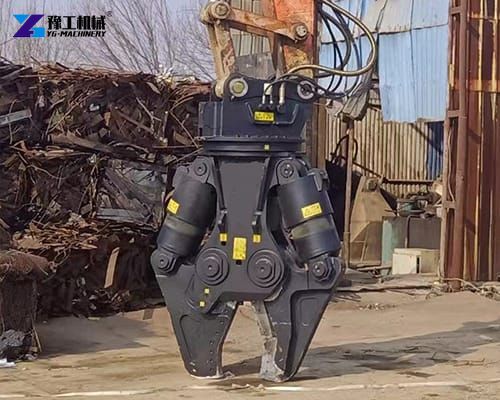
Choosing the ideal hydraulic shear attachment for an excavator requires a systematic evaluation of several variables.
- The carrier machine’s operating weight is the primary constraint; selecting a shear that is too heavy compromises stability and lift capacity, while an undersized shear wastes the excavator’s potential.
- Next, assess the primary material types: structural steel, rebar, pipes, or mixed demolition debris. For heavy structural sections, prioritize shear force over opening size; for bulky but light materials, a larger opening is more productive.
- Hydraulic compatibility is non-negotiable—verify the excavator’s auxiliary flow and pressure against the shear’s requirements. For example, a model demanding 320 MPa and 350 L/min cannot perform on a machine delivering only 280 MPa and 250 L/min.
- Also, consider the working environment: demolition of reinforced concrete requires a shear with a concrete cracker or pulverizer combo, while scrap yards might value a 360-degree rotator for maneuvering.
- Finally, evaluate blade availability and cost; four-sided blades offer four wear lives per set, reducing downtime.
Hydraulic Shear Attachment for Sale in YG Machinery
The hydraulic shear attachment for excavator represents a convergence of mechanical ingenuity, hydraulic power, and practical application. Whether you are dismantling a skyscraper, recycling end-of-life vehicles, or clearing industrial debris, this tool delivers unmatched efficiency, safety, and precision. By understanding its structural components, operational principles, and maintenance needs, operators can maximize uptime and minimize costs. The data-driven selection process—matching excavator weight, flow, and pressure to models like the YG-180, YG-290, and YG-390—ensures optimal performance across all scales. As technology advances, we can expect even smarter, greener, and more adaptable shears to emerge, further cementing their role as an indispensable asset.