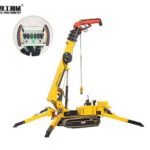
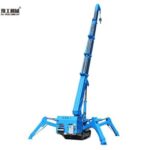
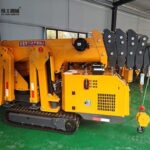
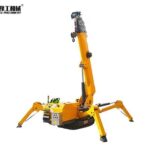
Tracked spider crane is a compact, all-terrain lifting machine purpose-built to solve the most challenging lifting tasks that traditional cranes cannot access. Named for its spider-like extendable outriggers and rugged tracked undercarriage, this specialized equipment delivers exceptional stability, maneuverability, and lifting power in confined, uneven, or hard-to-reach workspaces. Unlike standard mobile cranes that require wide, flat access roads and large setup zones, the crawler spider crane can navigate narrow doorways, climb gentle slopes, and operate safely on indoor floors, making it a go-to solution for modern construction, maintenance, and industrial projects where space and terrain are major constraints. For procurement specialists and equipment operators, understanding every aspect of this machine directly translates to better project efficiency, lower operational costs, and safer job site performance.

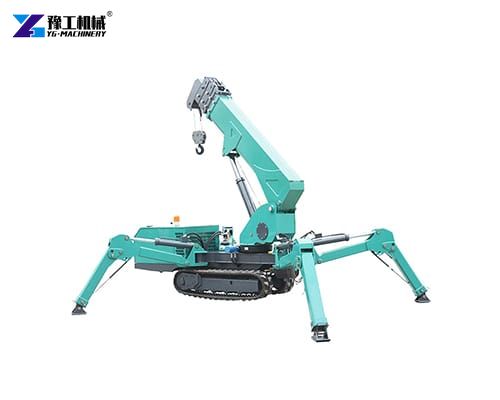
Technical Specifications of the Tracked Spider Crane
| Model | YG-1.2 | YG-1.5 | YG-2 | YG-3 | YG-4 | YG-5 | YG-8 | YG-10 | YG-12 | YG-16 | |
| Maximum Rated Lifting Capacity(T) | 1.2 | 1.5 | 2 | 3 | 4 | 5 | 8 | 10 | 12 | 16 | |
| Self-weight (T) | 1.3 | 1.7 | 1.8 | 2.7 | 3 | 6.7 | 8.7 | 10.5 | 12.5 | 16.5 | |
| Max. working radius | 5.35 | 6 | 6 | 10 | 13 | 15 | 18 | 18 | 19 | 23 | |
| Max. lifting height (m) | 6.3 | 6.5 | 6.5 | 10.8 | 15 | 17 | 21 | 21 | 21 | 25 | |
| Winches | Hook rising speed | 0-8m/min (4 rope) | 0-8m/min (4 rope) | 0-8m/min (4 rope) | 0-8m/min (4 rope) | 0-8m/min (4 rope) | 12m/min (4 rope) two-speed | 12m/min (4 rope) two-speed | 11m/min (4 rope) two-speed | 10m/min (4 rope) two-speed | 10m/min (4 rope) two-speed |
| Wire rope spec | Φ8mm×45m | Φ8mm×45m | Φ8mm×45m | Φ8mm×45m | Φ8mm×45m | Φ11mm×60m | Φ12mm×80m | Φ12mm×100m | Φ12mm×120m | Φ12mm×160m | |
| Telescopic | Boom type | 2m×4-section lifting arm (customizable) | 2m×4-section lifting arm (customizable) | 2m×4-section lifting arm (customizable) | 2.4m×6-section lifting arm (customizable) | 2.8m×7-section lifting arm (customizable)) | 4m×5-section lifting arm (customizable)) | 5m×5-section lifting arm (customizable)) | 5m×5-section lifting arm (customizable)) | 5m×5-section boom (customizable)) | 6m×5-section lifting arm (customizable)) |
| Boom length/time | 2.5-6.3m / 20s | 6.5m / 20s (customizable) | 6.5m / 20s (customizable) | 3.1-10.8m / 20s (adjustable) | 3.1-15m / 20s (adjustable) | 4.5-17m / 54s (adjustable) | 5.5-21m / 54s (adjustable) | 12.3m / 58s (customizable) | 12.3m / 60s (adjustable) | 12.3m / 40s (adjustable) | |
| Telescopic arm length | 5.5m-21m | 5.5m-21m | 6.5m-25m | ||||||||
| Luffing device | Boom angle/time | 0-78° / 13s | 0-78° / 13s | 0-78° / 13s | 0-78° / 13s | 0-78° / 13s | 0-78° / 13s | 0-78° / 13s | 0-78° / 15s | 0-78° / 17s | 0-78° / 17s |
| Cyclotron | Rotation angle/speed | 0-360° continuous / 60s | 0-360° continuous / 60s | 0-360° continuous / 60s | 0-360° continuous / 60s | 0-360° continuous / 60s | 0-360° continuous / 38s | 0-360° continuous / 38s | 0-360° continuous / 40s | 0-360° continuous / 42s | 0-360° continuous / 42s |
| Outrigger | Forms of outrigger movement | Manual screw-out + hydraulic auto support (3-section legs retractable) | Manual screw-out + hydraulic auto support (3-section legs retractable) | Manual screw-out + hydraulic auto support (3-section legs retractable) | Manual screw-out + hydraulic auto support (3-section legs retractable) | Manual screw-out + hydraulic auto support (3-section legs retractable) | Manual screw-out + cylinder support (2-section leg) | Manual screw-out + cylinder support (2-section leg) | Manual screw-out + hydraulic telescopic + hydraulic support | Manual screw-out + hydraulic telescopic + hydraulic support | Manual screw-out + hydraulic telescopic + hydraulic support |
| Maximum extension amplitude(mm) (L×Rear×Front) | 3580×3380×3380 | 3600×3400×3400 | 3620×3440×3470 | 4300×3700×4300 | 4230×3830×4310 | 5800×4900×5600 | 7000×5070×6700 | 6960×5900×6620 | 7600×5600×6700 | 7860×6200×6200 | |
| Running Gear | Walking mode | Hydraulic drive | Hydraulic drive | Hydraulic drive | Hydraulic drive | Hydraulic drive | Hydraulic drive (high/low speed) | Hydraulic drive (high/low speed) | Hydraulic drive | Hydraulic drive | Hydraulic drive |
| Walking speed | 0-2.5 km/h | 0-2.5 km/h | 0-2.5 km/h | 0-2.5 km/h | 0-2.5 km/h | 0-2.5 km/h | 0-2.5 km/h | 0-2.5 km/h | 0-2.5 km/h | 0-2.5 km/h | |
| Gradeability | 25° (36%) | 25° (36%) | 25° (36%) | 25° (36%) | 25° (36%) | 25° (36%) | 25° (36%) | 25° (36%) | 25° (36%) | 25° (36%) | |
| Crawler structure | Steel track | Steel track | Steel track | ||||||||
| Electrical | Voltage | AC380V | AC380V | AC380V | AC380V | AC380V | |||||
| Engine | Manufacturer | Honda (customizable) | Honda (customizable) | Honda (customizable) | Changchai (customizable) | Changchai (customizable) | Yuchai (customizable) 58kW | Yuchai (customizable) 58kW | Yunnei (customizable) 76kW | Yunnei (customizable) 76kW | Yuchai (customizable) 85kW |
| Engine model | 390CC | 390CC | 390CC | Changchai 380G 3-cylinder 14.7kW | Changchai 380G 3-cylinder 14.7kW | 490CC | 490CC | ||||
| Starting mode | Electric / manual | Electric / manual | Electric/manual | Electric start | Electric start | Electric start | Electric start | Electric start | Electric start | Electric start | |
| Start performance | -50℃ ~ 45℃ | -50℃ ~ 45℃ | -50℃ ~ 45℃ | -50℃ ~ 45℃ | -50℃ ~ 45℃ | -50℃ ~ 45℃ | -50℃ ~ 45℃ | -50℃ ~ 45℃ | -50℃ ~ 45℃ | -50℃ ~ 45℃ | |
| Fuel/capacity | Gasoline / 6L | Gasoline / 8L | Gasoline / 8L | Diesel / 12L | Diesel / 12L | Diesel / 35L | Diesel / 35L | Diesel / 40L | Diesel / 40L | Diesel / 45L | |
| Battery capacity | 12V60AH | 12V60AH | 12V60AH | 12V60AH | 12V60AH | 24V45AH | 24V45AH | 24V45AH | 24V45AH | 24V45AH | |
| Fuel consumption | 274 g/kW·h | 274 g/kW·h | 274 g/kW·h | 274 g/kW·h | 274 g/kW·h | ||||||
| Noise level | ≤81.5 dBA(1m) | ≤81.5 dBA(1m) | ≤81.5 dBA(1m) | ≤81.5 dBA(1m) | ≤81.5 dBA(1m) | ||||||
| Operating | Operation mode | Manual / optional remote control | |||||||||
| Standard configuration | Gasoline engines can be replaced with diesel engines | Gasoline engines can be replaced with diesel engines | Gasoline engines can be replaced with diesel engines | Diesel engine + electric motor (dual power) | Diesel engine + electric motor (dual power) | ||||||
| Overall dims (m) (L×W×H) | 2.48×0.65×1.5 | 2.5×0.65×1.5 | 2.78×0.71×1.62 | 3.5×0.8×1.85 | 4.25×1.0×1.83 | 4.7×1.5×2.25 | 6.15×1.6×2.25 | 5.9×1.8×2.3 | 6.15×1.86×2.48 | 7.35×2.13×2.68 | |
| Track spec (mm) (W×pitch×links) | 180 wide × 72 pitch (37 links) | 180 wide × 72 pitch (37 links) | 180 wide × 72 pitch (37 links) | 220 wide × 72 pitch (50 links) | 230 wide × 72 pitch (53 links) | 300 wide × 52.5 pitch (90 links) | 350 wide × 52.5 pitch (104 links) | 300 wide × 135 pitch (41 links) | 400 wide × 135 pitch (44 links) | 400 wide × 135 pitch (48 links) | |
| Optional | Torque Controller / remote control/cradle / hydraulic fly jib/ colors: red, green, yellow, white, grey, black | ||||||||||
What Is The Working Principle of A Compact Crawler Spider Crane?
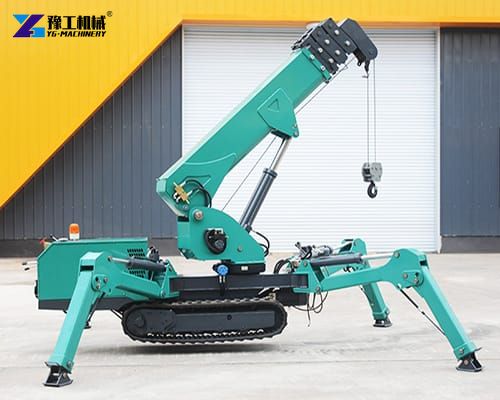
The tracked spider crane relies on two core systems to complete lifting work: the crawler running gear for site movement and the hydraulic boom lifting assembly for load hoisting. The crawler tracks distribute the machine’s weight evenly across the ground, lowering ground pressure to prevent sinking on soft soil, gravel or unfinished floors. When the crane reaches the work position, multi-section hydraulic outriggers extend outward to form a wide stable base. These outriggers can be individually adjusted to level the crane even on uneven surfaces, which is the key reason for the “spider” name, as the legs spread out like spider limbs.
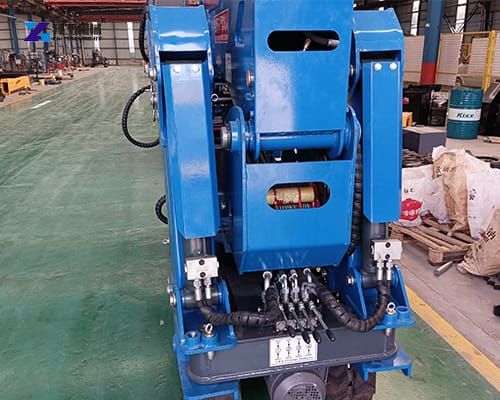
Once stabilised, the hydraulic pump delivers pressure to drive the telescopic boom and winch. The winch pulls the wire rope and hook assembly to lift the load. Operators can control boom extension, luffing angle, hook lifting speed and machine travel via manual levers or optional remote control. A built-in load moment limiter continuously monitors load weight and boom position. If the load exceeds the safe working limit, the system automatically stops hazardous movements to prevent tip-over accidents. The whole workflow follows simple hydraulic transmission logic, so operators can quickly master basic operation after standard training.
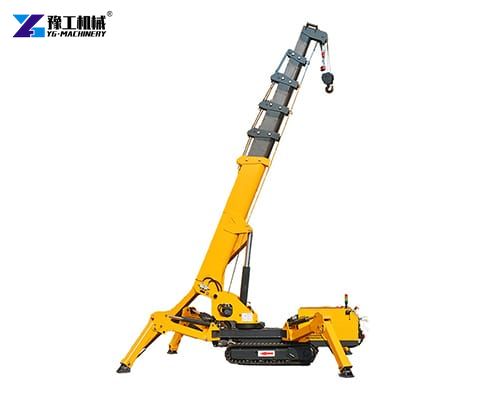
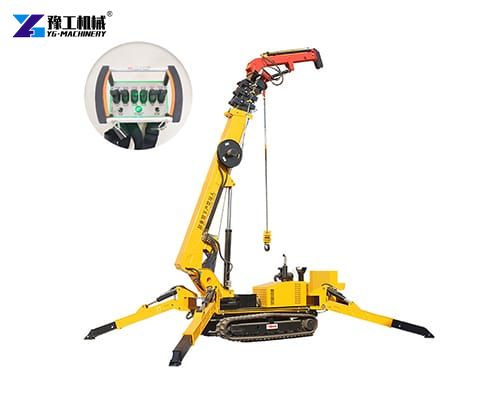
Common Application Scenarios For Tracked Spider Cranes
The unique footprint and lifting profile of mini spider cranes allow them to excel across a diverse range of challenging environments:
Glass Installation and Curtain Wall Fitting: Fitting oversized glass panels onto modern high-rise facades requires sub-millimeter precision. Equipped with vacuum suction attachments, spider cranes can lift and position heavy glass panes close to structural frames, even working from upper building floors or tight balconies.
Indoor Maintenance and Factory Upgrades: Manufacturing facilities often need machinery moved or overhead pipework installed without shutting down entire production lines. Compact transport dimensions, allow spider cranes to navigate standard doorway frames and factory aisles with ease.
Steel Structure Erection: On residential or commercial construction sites with limited space, these machines quickly position steel beams, trusses, and columns where larger truck-mounted cranes cannot park.
Restoration and Heritage Buildings: Renovating historical structures demands minimal ground pressure to prevent floor damage or foundation strain. Spider cranes distribute their operational weight evenly across broad outrigger pads, making them suitable for work on stone tiles, elevated decks, and historic grounds.
Subway, Tunnel, and Underground Projects: Deep excavation sites, basement work, and utility tunnels feature low ceiling clearances and restricted access points. Spider cranes can be lowered down access shafts via overhead hoist to perform internal rigging tasks.

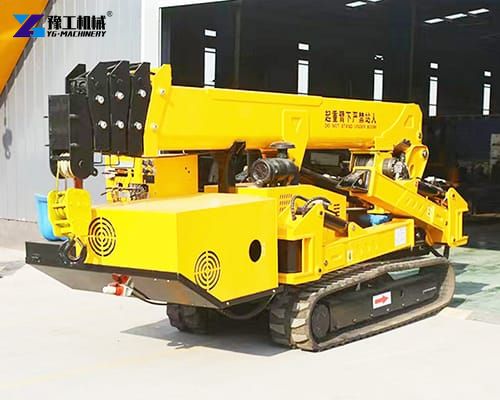
Core Performance Characteristics of Small Spider Cranes
Understanding key performance metrics helps project managers select the right machine configuration for demanding lifting setups:
Lifting Capacity and Reach Balance: Tracked spider cranes range from lightweight 1.2-ton micro models up to heavy-duty 16-ton capacity units. A typical mid-sized model offers maximum working radiuses extending from 5 to 23 meters and lifting heights up to 25 meters, providing significant reach without requiring a massive counterweight footprint.
Terrain Adaptability and Power Options: Designed for mixed indoor/outdoor work, these cranes feature versatile dual-fuel or electric power systems (AC380V options) alongside engine start capabilities tailored for extreme temperatures ranging from -50°C to 45°C. Their low center of gravity enables stable movement across soft mud, gravel, and incline ramps.
Control Precision: Modern spider cranes feature dual manual and proportional remote control options. Wireless remotes give operators variable speed adjustment over winches (reaching hook-rising speeds up to 12m/min) and smooth 360° continuous rotation, reducing payload sway during delicate placement tasks.
Advantages of Mini Spider Cranes
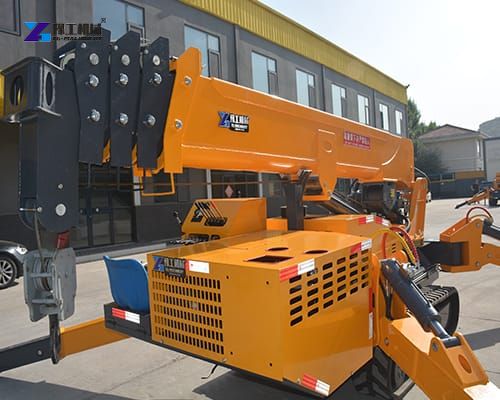
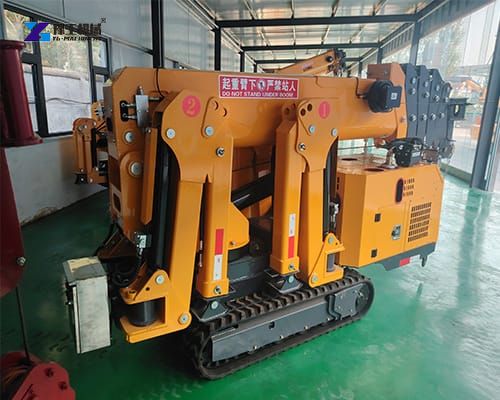
The biggest advantage of tracked spider cranes is their ultra-compact transport width. When folded, the crane can fit through narrow gates, building entrances, and tight alleyways, removing the need for costly site modification before lifting work starts. While spider crawler cranes only need a small area to deploy their outriggers. This feature cuts down site preparation time and reduces extra construction costs for project owners.
Ground protection is another major benefit. The wide crawler tracks spread machine weight over a larger area, so the crane creates much lower ground pressure compared to wheeled lifting machines. This means it can travel on asphalt, finished concrete floors, lawns and soft soil without easily causing surface damage or sinking. For indoor renovation projects where floor protection is critical, this advantage saves money on floor repair after construction.
Safety features are built into every tracked spider crane. Load moment protection systems stop unsafe lifting actions automatically. Independently adjustable outriggers allow levelling on slopes and uneven ground. Operators can use wireless remote control to stand at a safe distance from suspended loads. Maintenance work is also simple. Customisation options, including different boom lengths, power units and colour choices, help buyers tailor the machine for their local working conditions.
How to Select A Suitable Compact Spider Crane for Your Project?
When procurement staff start to source a tracked spider crane, there are several practical factors to consider before placing an order. First, confirm your maximum required lifting weight and maximum lifting height. Do not only look at the rated capacity at close range; check lifting capacity at your actual working radius, because lifting capacity drops as the boom extends outward. Many buyers make the mistake of only checking the headline tonnage, which can lead to selecting an underpowered machine.
Second, measure your site access. Check the width and height of entry doors, gates or passages the crane needs to pass through. Confirm floor load limits for indoor work. If you will use the crane mostly on rooftops or upper floors, calculate the machine’s self-weight carefully to avoid exceeding structural load limits.
Third, choose the right power type. Gasoline engines are quieter and fit indoor, well-ventilated spaces, while diesel engines provide longer runtime for all-day outdoor heavy-duty work.