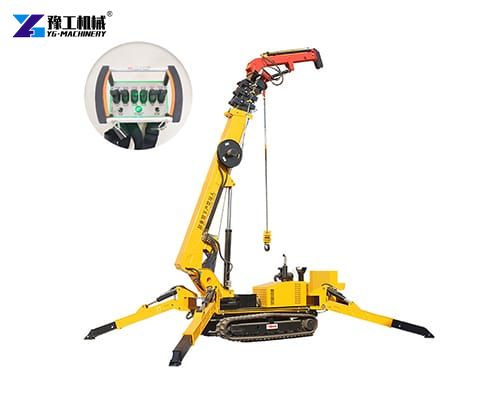
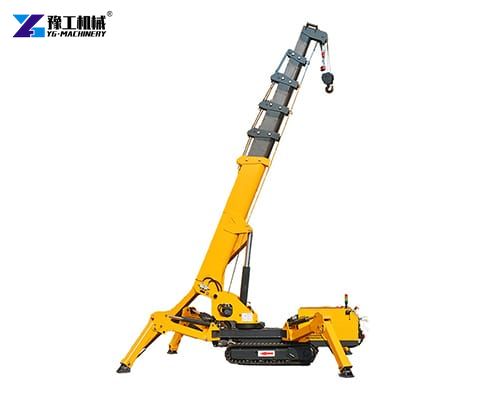
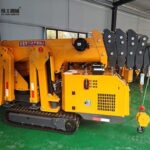
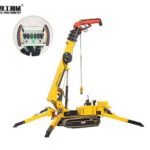
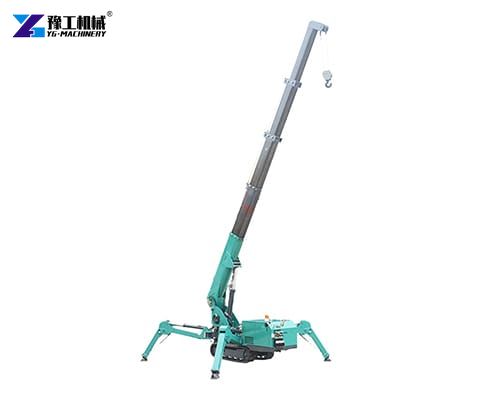
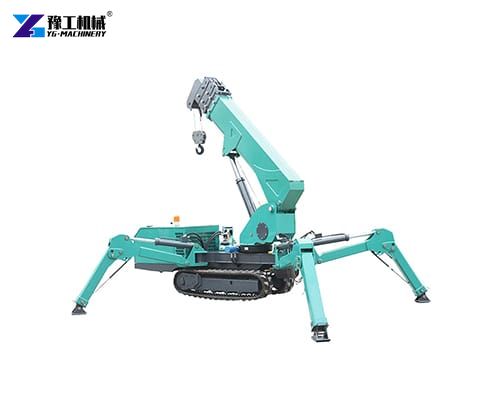
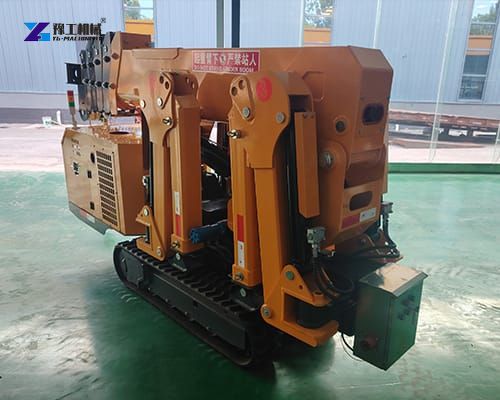
Mini crawler spider crane is a compact lifting machine designed for jobs where conventional mobile cranes or truck cranes cannot easily enter or operate. The term “spider” comes from the appearance of the deployed outriggers. When the supports are extended, the machine has a broad and stable footprint while the main body remains relatively compact. Combining a narrow crawler chassis, telescopic boom, hydraulic outriggers, and a rotating crane body, it can travel through restricted access areas and then establish a stable working position close to the lifting point. This makes it useful for construction, glazing, equipment installation, maintenance, landscaping, steelwork, and other projects where lifting capacity must be combined with mobility and a small working footprint. There are various models are available in different lifting classes, allowing people to select a machine according to load requirements, access conditions, lifting height, and site layout.
Mini Crawler Spider Crane Specifications
| Model | YG-1.2 | YG-1.5 | YG-2 | YG-3 | YG-4 | YG-5 | YG-8 | YG-10 | YG-12 | YG-16 | |
| Maximum Rated Lifting Capacity(T) | 1.2 | 1.5 | 2 | 3 | 4 | 5 | 8 | 10 | 12 | 16 | |
| Self-weight (T) | 1.3 | 1.7 | 1.8 | 2.7 | 3 | 6.7 | 8.7 | 10.5 | 12.5 | 16.5 | |
| Max. working radius | 5.35 | 6 | 6 | 10 | 13 | 15 | 18 | 18 | 19 | 23 | |
| Max. lifting height (m) | 6.3 | 6.5 | 6.5 | 10.8 | 15 | 17 | 21 | 21 | 21 | 25 | |
| Winches | Hook rising speed | 0-8m/min (4 rope) | 0-8m/min (4 rope) | 0-8m/min (4 rope) | 0-8m/min (4 rope) | 0-8m/min (4 rope) | 12m/min (4 rope) two-speed | 12m/min (4 rope) two-speed | 11m/min (4 rope) two-speed | 10m/min (4 rope) two-speed | 10m/min (4 rope) two-speed |
| Wire rope spec | Φ8mm×45m | Φ8mm×45m | Φ8mm×45m | Φ8mm×45m | Φ8mm×45m | Φ11mm×60m | Φ12mm×80m | Φ12mm×100m | Φ12mm×120m | Φ12mm×160m | |
| Telescopic | Boom type | 2m×4-section lifting arm (customizable) | 2m×4-section lifting arm (customizable) | 2m×4-section lifting arm (customizable) | 2.4m×6-section lifting arm (customizable) | 2.8m×7-section lifting arm (customizable)) | 4m×5-section lifting arm (customizable)) | 5m×5-section lifting arm (customizable)) | 5m×5-section lifting arm (customizable)) | 5m×5-section boom (customizable)) | 6m×5-section lifting arm (customizable)) |
| Boom length/time | 2.5-6.3m / 20s | 6.5m / 20s (customizable) | 6.5m / 20s (customizable) | 3.1-10.8m / 20s (adjustable) | 3.1-15m / 20s (adjustable) | 4.5-17m / 54s (adjustable) | 5.5-21m / 54s (adjustable) | 12.3m / 58s (customizable) | 12.3m / 60s (adjustable) | 12.3m / 40s (adjustable) | |
| Telescopic arm length | 5.5m-21m | 5.5m-21m | 6.5m-25m | ||||||||
| Luffing device | Boom angle/time | 0-78° / 13s | 0-78° / 13s | 0-78° / 13s | 0-78° / 13s | 0-78° / 13s | 0-78° / 13s | 0-78° / 13s | 0-78° / 15s | 0-78° / 17s | 0-78° / 17s |
| Cyclotron | Rotation angle/speed | 0-360° continuous / 60s | 0-360° continuous / 60s | 0-360° continuous / 60s | 0-360° continuous / 60s | 0-360° continuous / 60s | 0-360° continuous / 38s | 0-360° continuous / 38s | 0-360° continuous / 40s | 0-360° continuous / 42s | 0-360° continuous / 42s |
| Outrigger | Forms of outrigger movement | Manual screw-out + hydraulic auto support (3-section legs retractable) | Manual screw-out + hydraulic auto support (3-section legs retractable) | Manual screw-out + hydraulic auto support (3-section legs retractable) | Manual screw-out + hydraulic auto support (3-section legs retractable) | Manual screw-out + hydraulic auto support (3-section legs retractable) | Manual screw-out + cylinder support (2-section leg) | Manual screw-out + cylinder support (2-section leg) | Manual screw-out + hydraulic telescopic + hydraulic support | Manual screw-out + hydraulic telescopic + hydraulic support | Manual screw-out + hydraulic telescopic + hydraulic support |
| Maximum extension amplitude(mm) (L×Rear×Front) | 3580×3380×3380 | 3600×3400×3400 | 3620×3440×3470 | 4300×3700×4300 | 4230×3830×4310 | 5800×4900×5600 | 7000×5070×6700 | 6960×5900×6620 | 7600×5600×6700 | 7860×6200×6200 | |
| Running Gear | Walking mode | Hydraulic drive | Hydraulic drive | Hydraulic drive | Hydraulic drive | Hydraulic drive | Hydraulic drive (high/low speed) | Hydraulic drive (high/low speed) | Hydraulic drive | Hydraulic drive | Hydraulic drive |
| Walking speed | 0-2.5 km/h | 0-2.5 km/h | 0-2.5 km/h | 0-2.5 km/h | 0-2.5 km/h | 0-2.5 km/h | 0-2.5 km/h | 0-2.5 km/h | 0-2.5 km/h | 0-2.5 km/h | |
| Gradeability | 25° (36%) | 25° (36%) | 25° (36%) | 25° (36%) | 25° (36%) | 25° (36%) | 25° (36%) | 25° (36%) | 25° (36%) | 25° (36%) | |
| Crawler structure | Steel track | Steel track | Steel track | ||||||||
| Electrical | Voltage | AC380V | AC380V | AC380V | AC380V | AC380V | |||||
| Engine | Manufacturer | Honda (customizable) | Honda (customizable) | Honda (customizable) | Changchai (customizable) | Changchai (customizable) | Yuchai (customizable) 58kW | Yuchai (customizable) 58kW | Yunnei (customizable) 76kW | Yunnei (customizable) 76kW | Yuchai (customizable) 85kW |
| Engine model | 390CC | 390CC | 390CC | Changchai 380G 3-cylinder 14.7kW | Changchai 380G 3-cylinder 14.7kW | 490CC | 490CC | ||||
| Starting mode | Electric/manual | Electric/manual | Electric/manual | Electric start | Electric start | Electric start | Electric start | Electric start | Electric start | Electric start | |
| Start performance | -50℃ ~ 45℃ | -50℃ ~ 45℃ | -50℃ ~ 45℃ | -50℃ ~ 45℃ | -50℃ ~ 45℃ | -50℃ ~ 45℃ | -50℃ ~ 45℃ | -50℃ ~ 45℃ | -50℃ ~ 45℃ | -50℃ ~ 45℃ | |
| Fuel/capacity | Gasoline / 6L | Gasoline / 8L | Gasoline / 8L | Diesel / 12L | Diesel / 12L | Diesel / 35L | Diesel / 35L | Diesel / 40L | Diesel / 40L | Diesel / 45L | |
| Battery capacity | 12V60AH | 12V60AH | 12V60AH | 12V60AH | 12V60AH | 24V45AH | 24V45AH | 24V45AH | 24V45AH | 24V45AH | |
| Fuel consumption | 274 g/kW·h | 274 g/kW·h | 274 g/kW·h | 274 g/kW·h | 274 g/kW·h | ||||||
| Noise level | ≤81.5 dBA(1m) | ≤81.5 dBA(1m) | ≤81.5 dBA(1m) | ≤81.5 dBA(1m) | ≤81.5 dBA(1m) | ||||||
| Operating | Operation mode | Manual/optional remote control | |||||||||
| Standard configuration | Gasoline engines can be replaced with diesel engines | Gasoline engines can be replaced with diesel engines | Gasoline engines can be replaced with diesel engines | Diesel engine + electric motor (dual power) | Diesel engine + electric motor (dual power) | ||||||
| Overall dims (m) (L×W×H) | 2.48×0.65×1.5 | 2.5×0.65×1.5 | 2.78×0.71×1.62 | 3.5×0.8×1.85 | 4.25×1.0×1.83 | 4.7×1.5×2.25 | 6.15×1.6×2.25 | 5.9×1.8×2.3 | 6.15×1.86×2.48 | 7.35×2.13×2.68 | |
| Track spec (mm) (W×pitch×links) | 180 wide × 72 pitch (37 links) | 180 wide × 72 pitch (37 links) | 180 wide × 72 pitch (37 links) | 220 wide × 72 pitch (50 links) | 230 wide × 72 pitch (53 links) | 300 wide × 52.5 pitch (90 links) | 350 wide × 52.5 pitch (104 links) | 300 wide × 135 pitch (41 links) | 400 wide × 135 pitch (44 links) | 400 wide × 135 pitch (48 links) | |
| Optional | Torque Controller / remote control/cradle / hydraulic fly jib/ colors: red, green, yellow, white, grey, black | ||||||||||
How Does a Mini Spider Crane Work?
The operating process is straightforward but requires proper planning.
First, the mini crawler spider crane travels to the designated work area using its crawler system. The operator should assess the access route, ground condition, overhead clearance, and available working space before moving the machine.
Once the crane reaches the lifting position, the outriggers are deployed. These supports increase the machine’s stability and distribute operating loads over a larger area. The exact outrigger configuration depends on the machine model and site conditions.
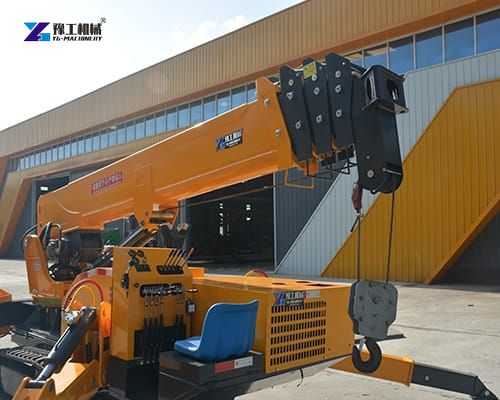
The telescopic boom then extends or retracts according to the required lifting radius and height. A hydraulic luffing mechanism changes the boom angle, while the slewing system allows the upper structure to rotate around the working area.
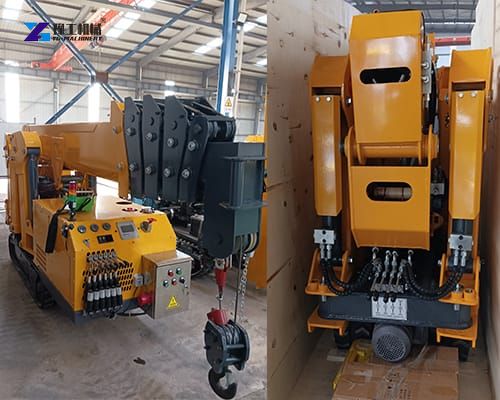
During lifting, the winch controls the wire rope and hook movement. The operator coordinates boom extension, boom angle, rotation, and hook movement to position the load accurately.
This operating principle gives a small spider crane an important advantage: the machine does not need to remain directly underneath the final installation point. It can establish a stable position nearby and use its boom to reach over obstacles or into restricted areas.

Why Compact Access Matters on Modern Job Sites
Access is often a bigger problem than lifting capacity.
A construction project may require a heavy glass panel, steel component, HVAC unit, stone element, or mechanical component to be installed inside a building or behind an existing structure. A large crane may have sufficient lifting capacity but still be unable to reach the site.
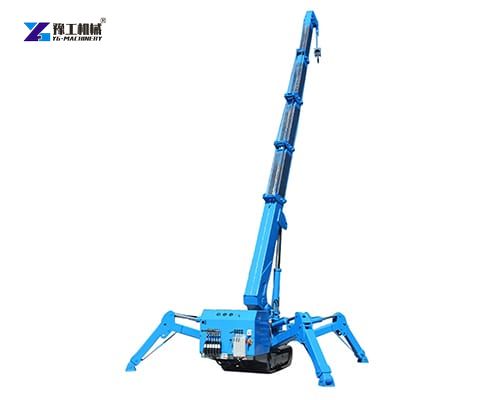
A small access mini crawler spider crane for confined spaces addresses this problem differently. Its compact crawler chassis can pass through areas that would be difficult for larger equipment. Once inside, its outriggers and telescopic boom create a much larger working envelope than the transport dimensions might suggest.
This can reduce the need for temporary structural openings, manual material handling, or complicated alternative lifting arrangements. In renovation projects, where access conditions are often fixed by the existing building, this flexibility can be especially useful.
Typical Applications of a Small Crawler Spider Crane
1. Glazing and Curtain Wall Installation
Glass installation is one of the most recognizable applications for compact spider cranes. Large glass panels can be difficult to move manually because of their size, weight, and fragility.
A mini crawler spider crane can position the lifting point close to the building façade and carefully move the panel into position. With suitable lifting accessories, it can support installation work in areas where a larger crane cannot practically operate.
This makes a mini spider crane for glass installation useful for commercial buildings, residential developments, façade renovation, and architectural projects.
2. Indoor Construction and Equipment Installation
Some lifting tasks take place inside factories, warehouses, workshops, shopping centers, or other buildings.
In these environments, equipment size becomes critical. A compact spider crane can be used for positioning machinery, air-conditioning equipment, electrical components, structural elements, and other heavy materials.
Before indoor use, buyers and operators should confirm doorway dimensions, floor loading capacity, ceiling clearance, ventilation requirements, and the machine’s power or emissions configuration.
3. Steel Structure and Building Construction
Steel components often need to be positioned accurately rather than simply lifted vertically. A telescopic boom and rotating upper structure provide useful control when installing beams, frames, supports, and other components.
The crawler base also allows the crane to move between lifting positions without requiring a conventional truck-mounted crane to enter the site.
4. Maintenance and Renovation Projects
Renovation work frequently involves unpredictable access conditions. Existing buildings may have narrow entrances, finished landscaping, underground services, or restricted vehicle access.
A compact crawler crane for renovation projects can help contractors bring lifting capability closer to the work area while minimizing the space required for setup.
It can also be useful for replacing machinery, lifting rooftop equipment, handling construction materials, or supporting maintenance work.
5. Landscaping and Outdoor Material Handling
The crawler configuration is also useful outside traditional construction. Depending on ground conditions and machine configuration, compact spider cranes can assist with landscaping materials, stonework, structural components, and maintenance tasks.
However, operators should never assume that a crawler footprint automatically makes every surface suitable. Operators must still assess ground bearing capacity, slope, outrigger pressure, and local site conditions.
Core Performance: Capacity, Reach, and Working Range
The most important specifications for purchasing a mini crawler spider crane are not always the largest numbers in a catalog. Buyers should consider how the machine performs at the actual working radius required on site.
A crane may have a high maximum lifting capacity close to the machine but a significantly lower capacity when the boom is extended. Therefore, the load chart and working radius are essential when selecting equipment.
The product range shown in the specification table covers models from approximately 1.2-ton to 16-ton rated lifting capacity. Depending on the model, maximum lifting height reaches up to around 25 m. Smaller machines are intended for highly restricted access, while larger versions provide greater lifting capacity and working range.
For example, the compact end of the range includes machines with relatively narrow dimensions and short transport configurations, while larger models provide substantially greater lifting performance for demanding construction applications. These figures demonstrate why buyers should select the model based on working requirements rather than choosing purely by nominal capacity.
If you are looking for a spider crane and are unsure which model is appropriate, please contact us, and we will recommend the right machine for your projects.
Telescopic Boom and Precise Positioning
The telescopic boom is one of the most important components of a modern mini crawler spider crane.
Instead of relying on a fixed-length boom, telescopic sections allow the operator to adjust the boom length according to the lifting task. A shorter configuration can be useful when working close to the load, while extension provides additional horizontal or vertical reach when access to the lifting point is restricted.
The specification table shows several boom configurations across the range, from compact multi-section systems to longer telescopic arrangements. Some models also provide adjustable boom lengths, giving operators greater flexibility for different lifting conditions.
The practical benefit is not simply greater reach. Telescopic adjustment can help the operator position the hook more accurately while maintaining an appropriate working radius.
Crawler Mobility for Difficult Access
A major reason to choose a mini crawler spider crane is its ability to move around a worksite without depending on conventional road wheels.
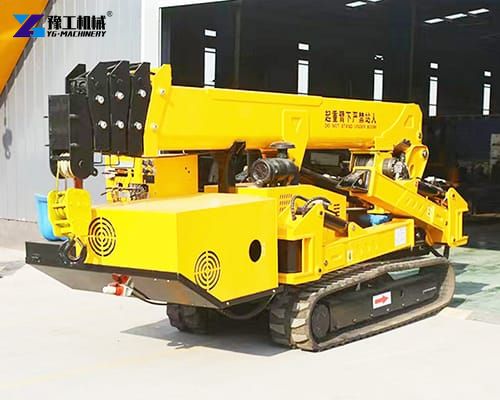
The crawler undercarriage provides continuous contact with the ground and allows the machine to travel across suitable construction surfaces. The specification table indicates a typical travel speed of around 0–2.5 km/h for many models, with climbing capability listed at up to 25° or 36%.
Actual mobility depends heavily on surface conditions. Operators should consider loose soil, mud, slopes, steps, underground structures, floor strength, and other obstacles before driving the crane.
Some larger models use steel tracks, while other configurations are designed around different crawler arrangements. This gives buyers options depending on the intended working environment.
Engine and Power Options
Power configuration is another important consideration, especially for indoor projects.
The specification range includes gasoline and diesel engine configurations, while certain models are described with dual-power arrangements involving a diesel engine and electric motor. Smaller machines can also use compact gasoline engines.
For outdoor construction, engine-powered operation can provide practical mobility and lifting performance without depending entirely on external electrical infrastructure.
For indoor or semi-enclosed work, however, emissions, ventilation, noise, and local regulations should be considered carefully. An electric-assisted or dual-power configuration may be more suitable where exhaust emissions need to be controlled.
The choice should therefore be based on the jobsite rather than simply engine power. Buyers should consider whether the crane will primarily work indoors, outdoors, or across both environments.
Choosing the Right Mini Crawler Spider Crane
Selecting a crane begins with the load, but it should not end there.
1. Define the Actual Load
Determine the maximum weight that must be lifted, including the lifting accessories where applicable. Avoid selecting a crane only according to an estimated average load.
2. Measure the Working Radius
The horizontal distance between the crane and the load can have a major impact on lifting capacity. Measure the real lifting position rather than using the straight-line distance between two points on a site plan.
3. Check Required Height
Identify the highest point where the load needs to be placed. Consider building floors, roof edges, structural openings, and any required clearance above the installation position.
4. Measure Access Routes
Record doorway widths, gate dimensions, corridor widths, ceiling heights, and turning space. A crane that meets the load requirement is not useful if it cannot reach the work area.
5. Evaluate Ground Conditions
Check the floor or ground capacity before the machine arrives. This is particularly important when operating on suspended floors, finished surfaces, soft soil, slopes, or areas containing underground structures.
6. Consider Power Requirements
For indoor work, determine whether engine emissions are acceptable. For long-term projects, also consider fuel availability, electrical supply, maintenance access, and local environmental requirements.
Compact Crawler Spider Cranes for Sale in YG Machinery
A mini crawler spider crane is designed for one of the most difficult lifting problems in modern construction: moving and positioning heavy loads where space is limited. Its compact crawler chassis helps it reach restricted areas, while telescopic boom sections, hydraulic luffing, slewing, and deployable outriggers provide the flexibility needed for precise lifting.
For buyers, the right model should be determined by the complete job requirement rather than maximum capacity alone. Load radius, lifting height, access dimensions, ground conditions, power source, working environment, maintenance support, and transport requirements all deserve attention.
For operators, correct setup, load-chart compliance, ground assessment, regular inspection, and controlled lifting remain essential regardless of machine size.
For projects involving glass, steel, machinery, building renovation, indoor installation, landscaping, or other restricted-access lifting tasks, a compact spider crane can provide a practical bridge between manual handling and large-scale crane equipment.
If your projects require different capacity levels, choosing the right combination of lifting capacity, boom reach, access size, power system, and support equipment can help create a more efficient lifting solution for the specific jobsite.
For more details about this machine, please contact us freely and we will reply to you as soon as possible.